The Small Isles: Rum, Eigg, Muck, Canna
Transport - Cruises - Sightseeing - Accommodation - Books

View from Muck to Eigg
How to get there
Caledonian Macbrayne runs a ferry service from Mallaig to the Small Isles 6 days a week. Tel: 0800 066 5000. Cycles can be carried for a small charge. No cars (except residents'). You stand a good chance of seeing whales, dolphins and porpoises.
A trip on the CalMac ferry allows you to see most of the islands on a day cruise. You can get combined bus/ferry tickets from Fort William to Mallaig and then cruise to the Small Isles. Visit the CalMac ferry web site for details.
Other day cruises operate in the summer on local boats from Mallaig and Arisaig:
- MV Western Isles offers cruises to Loch Nevis (Inverie and Tarbert) from Mallaig harbour. Children go half-price. Tel: 01687 46 23 20.
- AquaXplore is an offshore RIB (Rigid Inflatable Boat) operating from Elgol on Skye to the isles of Rum and Canna. Advance booking recommended. Telephone 01471 866 244 or freephone 0800 731 3089.
- Sea.Fari Adventures offers scheduled boat trips from Mallaig and Armadale on Skye to cruise around the Small Isles and Loch Nevis (Knoydart) and go whalespotting. Contact Peter Fowler. Tel: 01471 833316 / Mobile: 0797 3509387.
- Arisaig Marine runs cruises to the Small Isles giving you between 2 and 5 hours ashore on the islands of Eigg, Muck and Rum. The MV Sheerwater operates daily timetables from late April until late September, departing Arisaig at 11am. Tel: 01687 450224. The harbour office also contains a tea room, showers, toilets, shop and a laundrette.


www.expedia.co.ukBased at the pontoons in Kyle of Lochalsh, Red Moon Cruises offer tailor made holidays for up to 4 people sleeping in 3 cabins (1 double and 2 single). The cruising area covers Skye, Knoydart, the Small Isles, Wester Ross and the coastline north and south of Lochalsh. Contact Scott and Mary. Tel: 07768 101667.
For any quiz participants out there looking for the colloquial name for the Small Isles, the answer you are probably looking for is "cocktail islands", a phrase which is thought to have been used by a journalist several years ago, although is not really used locally.
Tours
North West Frontiers offer guided walking trips to the Small Isles.If you intend to go hiking, particularly in the hills, you will need the scale of maps provided by the Landranger series (2cm per mile) produced by the Ordnance Survey which is the official map agency of the UK. These can be purchased via Amazon in the UK:

ISLE OF RUM
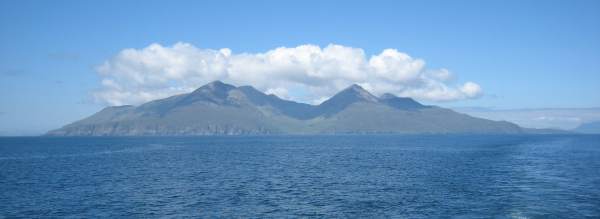
Photo copyright The Internet Guide to Scotland - More photosBought by the Nature Conservancy Council (now called NatureScot) in 1957, it is one of Scotland's finest National Nature Reserves. It is of international importance for many of its plants, habitats and birds. Guided day walks are available in the summer, looking at the nature, wildlife, archaeology and geology of the island. Visitors are welcome to follow the 2 simple nature trails laid out around the village.
Visit the NatureScot web site to learn more about the Reserve and its wildlife.
On a visit to Rum you may be rewarded by sightings of deer, otters, seals, goats and eagles. Over 100,000 Manx shearwaters nest in the hills. Be warned though, the island is said to have the highest rainfall in the Inner Hebrides thanks to its 2000 foot high mountains which catch all the clouds coming in from the Atlantic. And the midges are huge apparently! The island has a population of around 22 (2011 census).
Rum was the site for the reintroduction of sea eagles in Scotland. The red deer research by Edinburgh and Cambridge Universities is one of the longest running studies of a population of large mammals anywhere in the world.
The Rum Cuillin mountains are the remains of a huge, ancient volcano and attract geologists from all over the world. Deposits of platinum and other minerals have been found on the island by scientists from Essex University in England - but not enough to start mining!
|
Overlooking Loch Scresort, a sheltered bay halfway up the east
coast where the ferry arrives, sits the reddish form of Kinloch Castle, an extravagant Edwardian dream,
built by wealthy industrialist George Bullough in 1900 and later owned by Scottish Natural Heritage (now known as NatureScot).
The castle is on the market for sale (as of March 2023).
The castle is currently fenced off and not open.
|
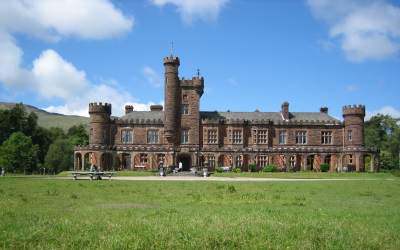 Photo copyright The Internet Guide to Scotland - More photos |
Kinloch means 'at the head of the loch'. The Bullough family mausoleum can also be visited if you want to walk over to it on the other side of the island.
It is thought that George Bullough changed the island's original Gaelic name from Rum to Rhum because he didn't want the island associated with the alcholic drink and it was then changed back to its original name in 1991 by the then Nature Conservancy Council.Accommodation on Rum:
Please note that the Hostel at Kinloch Castle closed down.
- Rum Bunkhouse has 4 dorms and 1 twin room (20 people). Suitable for individuals, families or groups. Living / dining space and 2 self-catering kitchens. Wheelchair access.
Also available: 2 camping cabins and campsite. 10 minutes walk from the ferry terminal.- Ivy Cottage Guest House offers dinner, bed & breakfast accommodation in 2 ensuite rooms. Contact: Fliss. Tel: 01687 462744.
Also available: Bramble Bothy - a shepherd's hut for 2.- 2 bothies (at Dibidal and Guirdal) run by the Mountain Bothy Association.
There is a well stocked shop in the village. Apart from groceries it also sells local crafts, postcards, stamps and souvenirs. Tel: 01687 460328.
The Village Hall is home to Kim's Kitchen which offers meals, cakes and drinks.
The otter hide is situated along a path which is easily reachable from the ferry terminal (turn left at the top of the pier).For additional information, visit the community web site: www.isleofrum.com
For local news, read the report from Rum every month in the local community newspaper West Word.
For Books about Rum - see below.
ISLE OF EIGG
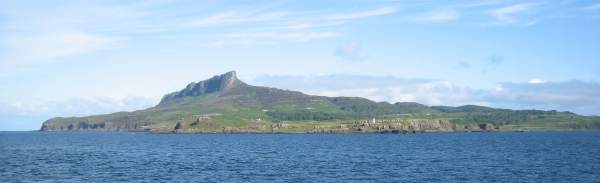
Photo copyright The Internet Guide to Scotland - More photosEigg is the second largest in the Small Isles group. Its distinctive outline is provided by a sloping ridge of lava known as the Sgurr which runs down the island like the backbone of some prehistoric creature. In fact the name Eigg comes from the Gaelic word meaning 'notch'.
If you walk along the road from the pier through the moors, you will reach Laig Bay. About a mile to the north are the Singing Sands of white quartz. There are also a few historic ruins on the island including Iron Age forts, a 6th century Christian church and Viking burial mounds.
In August 2020, researchers found a 166 million-year-old fossil thought to belong to a stegosaurian dinosaur.The island has been bought and sold several times in the past. Not all of the owners have been particularly liked by the inhabitants whose supplies are transported on the ferry from Mallaig. After many empty promises, the German owner who bought it in 1995 put the island up for sale. In August 1996, the islanders launched a public appeal to raise money so that Eigg could be properly managed by the islanders themselves in partnership with the Scottish Wildlife Trust and the Highland Council. In April 1997 their offer of 1.5 million pounds was finally accepted and they happily took possession on 12 June 1997.
By the ferry pier, the Galmisdale Bay Cafe, Bar & Restaurant (formerly known as the Eigg Tearoom) offers food all day (Tel: 01687 482487). Closed Wednesdays and Sundays. Next door is a fully licensed shop with post office and crafts.
A minibus meets the ferry and can give you a lift.
Eigg Adventures offers bike hire plus wilderness trips with kayaking, mountain biking and walking. Tel: 01687 315012.The Cleadale Crofting Museum (or Tigh Iain Dhonnachaidh - Gaelic for croft number 6) shows the way people used to live on the island. It is looked after by Eigg History Society in an old blackhouse. Admission free. Donations welcome.
To find out what's happening on the island today, read the news report from Eigg every month in the local community newspaper West Word.
Photos and more info are on the Eigg community web site. Also see the latest news from Eigg on Twitter.Accommodation on Eigg includes:
- Lageorna at Cleadale offers B&B and self catering and a restaurant. Tel: 01687 460081.
- Kildonan House B&B, Isle of Eigg PH42 4RL. 1 double & 2 twin rooms. Tel: 01687 482 446
- The Glebe Barn (22 people) and Apartment (2-3 people). 1 mile from harbour. Ideal for groups.
- Eigg Organics - bothy, yurt and campaing. Contact Sue Hollands. Tel: 07482 622122.
More details about various self catering properties (cottages, yurts, bothies) are given on the Eigg community web site.
For Books about Eigg - see below.
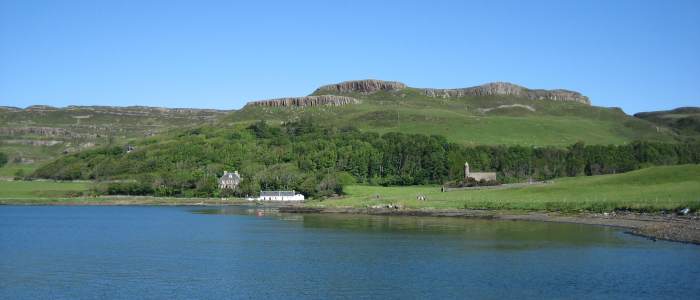
ISLE OF MUCK
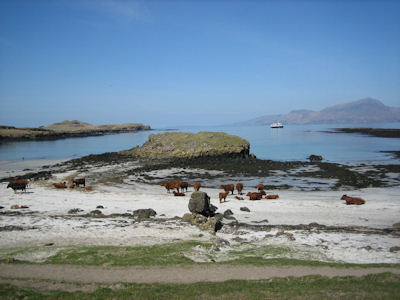
Photo copyright The Internet Guide to Scotland 2010 - More photos
|
Run as one large farm, the island is the smallest and flattest of the group, but there is still lots to see and do for those who enjoy getting away from it all. Population around 30.
The craft shop, tearoom and restaurant have a wide range of meals available (tel: 07908956822). Open April-September. For more info and photos of the island, visit the community web site: isleofmuck.com |
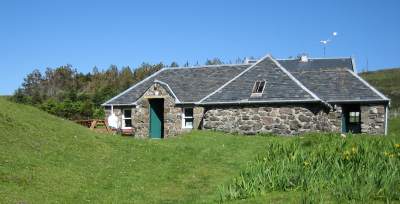 Craft shop & restaurant photo copyright The Internet Guide to Scotland - More photos |
Accommodation on Muck:
- 3 self-catering cottages and also a Yurt which is available May-September.
- Gallanach Lodge: newly built luxurious accommodation with 8 bedrooms offering Dinner, Bed & Breakfast. Contact Mary and Toby Fichtner-Irvine. Tel: 01687 462 365.
- The Bunk House (near the The Craft Shop & Tearoom): 4 small bedrooms (3 rooms with bunkbeds and 1 double room), kitchen, living area, 2 toilets and shower. Contact Ruth MacEwen. Tel: 01687 462042.
- Camping on the island is free of charge but check at the Craft Shop for good sites.
- Port Mor House and Godag House B&B: currently closed.
ISLE OF CANNA
Photo copyright The Internet Guide to Scotland - More photosThe furthest of the Small Isles from the mainland. From afar, it appears small and whale-shaped, with a solitary stack rising out of the sea near the east coast. Currently in the care of the National Trust for Scotland and with a population of around 20. Looking out over to Skye sits Compass Hill, so called because the iron in its basaltic rock affects compasses up to three miles away.
This is a beautifully scenic island and a car is not really needed for exploration (non-residents are not allowed to bring vehicles to the island).
10 safe yacht moorings are available at £15 per night - just pick up and pay online or at Canna Community Shop.Canna Community Shop stocks a wide range of groceries, gifts and local crafts. This shop is open 24/7 and run on an honesty basis with profits used to fund community projects. Café Canna opens for the summer season from May to early September. They serve light snacks, lunches and evening meals. Open daily except Tuesdays. Booking recommended. Tel: 01687 482 488.
The Canna Community Development Trust has a community space at the Shearing Shed for events.
As for local events, 2019 was the start of the annual Canna 10km trail race and Canna hosts the Small Isles Games every 4 years.Saint Columba's Presbyterian Church was built in 1913 and has a very nice ornamental wrought-iron gate. Rarely used nowadays, it is called the 'rocket church'. The Roman Catholic church, originally built around 1770 is St Columba's and has a plaque in memory of Margaret Fay Shaw and John Lorne Campbell who lived in Canna House.
Canna House and its amazing archives will hopefully be open to visitors in 2025 after renovations work. Owned by the National Trust for Scotland. The archivist Fiona Mackenzie posts updates on Facebook and writes a monthly column in West Word which you can read online.
Canna Cats Galore is a quirky trail for children featuring 12 brightly painted lifesize stone Siamese cats which are hidden around Canna Bay. This celebrates the history of John and Margaret Campbell who lived at Canna House with numerous cats over many decades.
Ray Perman, author of The Man Who Gave Away His Island, A Life of John Lorne Campbell of Canna, writes a blog about Canna.
Connected to Canna by a wooden bridge is the tidal island of Sanday. St. Edward's Chapel was restored as an arts centre but the project failed and has been disused since 2016.
The Canna Community Development Trust has a wealth of info about visiting the island.
The Canna Local History Group has a useful web site.Accommodation on Canna:
- Tighard Guest House has 3 double/twin rooms. Tel: 01687 462474.
- Canna Self Catering has 3 cottages on Sanday overlooking Canna.
- Canna Campsite has tent pitches, camping pods, caravans and Canna Bunkhouse for visitors. Cookshack, toilets, showers. Pets welcome.
Books about Canna:
- Canna: The Story of a Hebridean Island was written by former owner John Lorne Campbell who deeded the island to the National Trust for Scotland. Available as a paperback from Amazon.com (commission link) and Amazon.co.uk (commission link).
- His widow, an American lady called Margaret Fay Shaw (Campbell), who lived in Canna House, wrote her autobiography From the Alleghenies to the Hebrides. First published in 1995, it is recommended as a very good read. It is available from Amazon.com (commission link) and Amazon.co.uk (commission link) (January 2000 paperback edition).
- The Man Who Gave Away His Island: A Life of John Lorne Campbell of Canna is a biography by Ray Perman.
Books
|
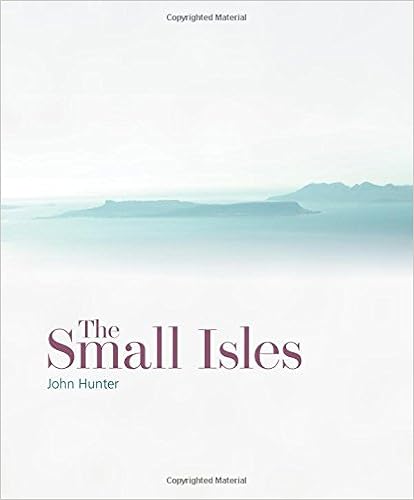
The Small Isles
Explore the history and heritage of the Small Isles in John Hunter's 2016 book for Historic Environment Scotland. This reference book has some excellent photos. Order your copy from Amazon.com (commission link) or Amazon.co.uk (commission link) |

|
A Drop in the Ocean: The Story of the Isle of Muck
Read the fascinating tale of one of the Hebrides unique thriving small communities through the colourful anecdotes of Lawrence MacEwen, whose family have owned the island since 1896. A wonderfully benevolent, and eccentric character, his passion and love for the island and its continuing success, has always been of the utmost importance. Author: Polly Pullar. Published in July 2014. Order your copy from Amazon.com (commission link) or Amazon.co.uk (commission link) |

|
The Small Isles
For many a spectacular skyline and magnificent scenery is their first awareness of the islands off Arisaig and Mallaig, yet their history is as central as their geographic situation to the story of the Hebrides. It was their misfortune that economic change and historical accident led to their marginalisation and the loss of so much of that extraordinary past. This is the first book ever to be written on the collective history of these 4 islands. It provides a wide ranging, fresh and provocative analysis of these islands and their history. Includes maps, population tables, details of stone crosses, some b/w photos. Author: Denis Rixson. Paperback. 223 pages. Published in June 2001. Order your copy from Amazon.com (commission link) or Amazon.co.uk (commission link) |

|
Rum: Island of Deer
This new book by John A. Love reveals the human story of the island of Rum, both in the tragedy of the clearance and in the interlude of the Bullogh period when the folly at Kinloch was built. It also covers the history of the island stretching back to the mesolithic period and the earliest settlements in Scotland. Includes sections of old b/w photos, colour photos and portraits. Hardcover. 317 pages. Published in July 2001. Order your copy from Amazon.com (commission link) or Amazon.co.uk (commission link) |

|
Rum: Nature's Island
Review by HIGHLAND NEWS: If you have already been to Rum, then this book will make you return. If you have never been to Rum you will just have to go to this magical island. Written by Magnus Magnusson and published in co-operation with Scottish Natural Heritage to mark the 40th anniversary of the acquisition of Rum by its predecessor, The Nature Conservancy. Description by the publisher: Thoroughly researched and written in a lively accessible style, the book includes comprehensive coverage of the island's geology, animals and plants, and people, with a special chapter on the Edwardian extravaganza of Kinloch Castle. There is practical information for visitors to what was once known as the Forbidden Isle; the book provides details of bothy and other accommodation, walks and nature trails. It closes with a positive vision for the island's future: biologically diverse, economically dynamic and ecologically sustainable. Order your copy from Amazon.com (commission link) or Amazon.co.uk (commission link) |

|
Eigg: the Story of an Island
Written by Camille Dressler (a French resident on the island). Following the ownership battle for the island in 1997, this text tells the story of Eigg, from its earliest inhabitants to the present, detailing its recently-acquired independence and community ownership. The book draws extensively on oral history from the islanders themselves and from local archives, with stories of clans, pastimes, wartime, childhood and crofting. Paperback. 228 pages. Order your copy from Amazon.co.uk (commission link) |
Other accommodation is available on the mainland around Mallaig, Morar and Arisaig.
See the Road to the Isles web site accommodation page.
External Links:
The Hebridean Trust
Local news from the islands each month
Small Isles DVD by Cinescene